



HLS Streaming on Our Internet Radio Platform
HTTP Live Streaming (HLS) is an adaptive bitrate streaming protocol developed by Apple. It works by breaking the audio stream into small .ts (MPEG-TS) chunks, typically 2–10 seconds long, and serving them via standard HTTP (or HTTPS). A master playlist (.m3u8) dynamically lists available stream variants (e.g., 64 kbps, 128 kbps, 256 kbps), allowing players to switch quality in real time based on network conditions.
✅ Pros of HLS
- Adaptive bitrate: Listeners automatically get the best quality their connection can handle.
- Firewall-friendly: Uses standard HTTP(S), so it works everywhere - including mobile networks and strict corporate firewalls.
- Scalable: Easily served via CDNs and standard web servers.
⚠️ Cons of HLS
- Latency: Due to chunking and buffering, HLS typically adds 10–30 seconds of delay, making it unsuitable for real-time interaction.
- No real-time listener stats: Unlike Icecast or SHOUTcast, HLS is delivered over HTTP like regular web files - there’s no built-in way to count concurrent listeners or track who’s tuned in.
- Geo-blocking limitations: Since HLS chunks are served like static files, traditional IP-based geo-restriction at the stream level doesn’t work in our setup.
Clarifying HLS Misconceptions
Many confuse two types of .m3u playlists:
- Static playlist: A simple list of unrelated streams (e.g.,
http://radio.com:8080/stream_128,http://radio.com:8080/stream_64). - True HLS: A chunked, segmented live stream with time-sliced audio (
.tsfiles) and dynamic quality switching.
Our control panel uses the correct, standards-compliant HLS - live audio is split into short chunks, not a static playlist.
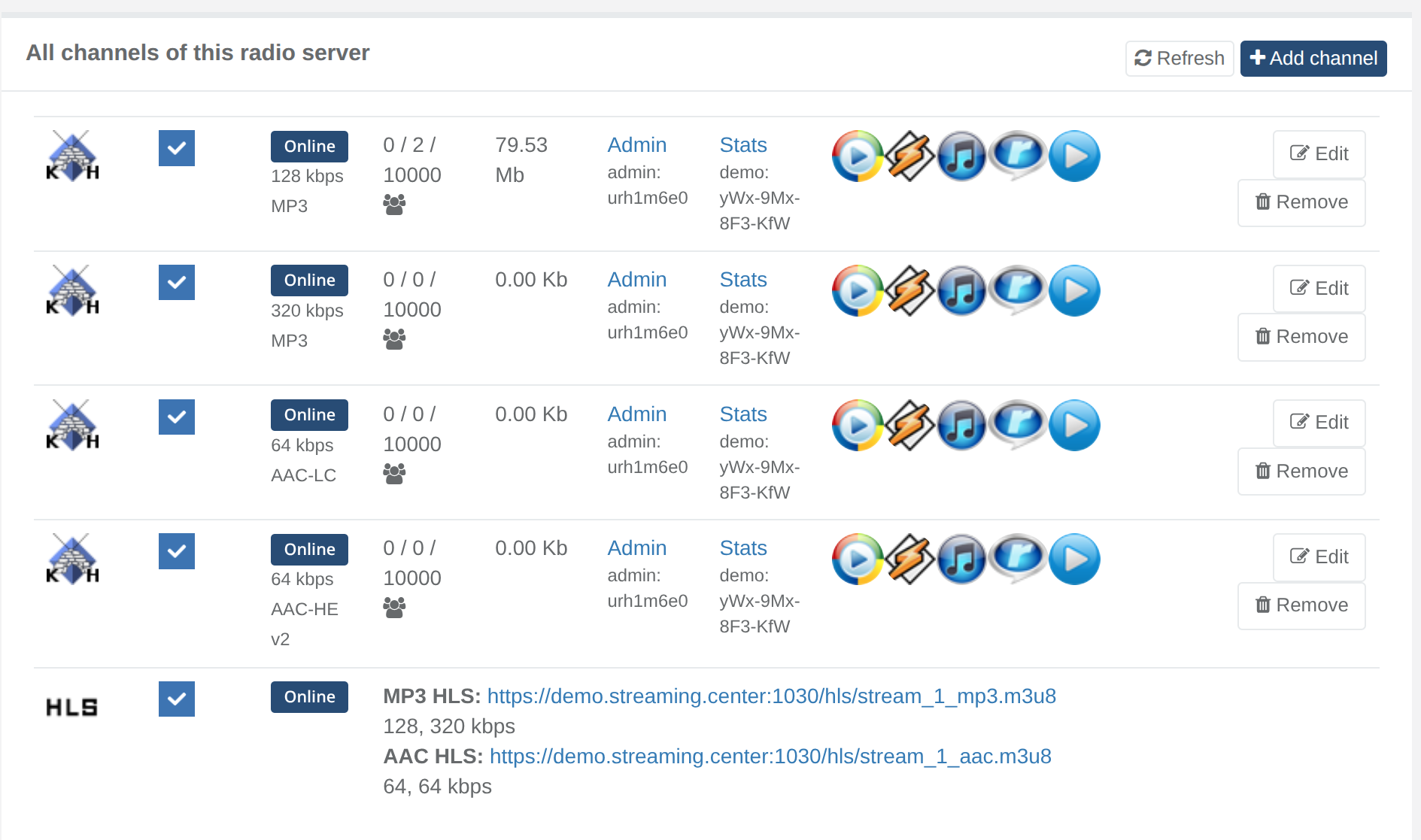
Additionally:
- MP3 and AAC streams are kept separate: You’ll get distinct HLS URLs for MP3 and AAC - never mixed.
- Multiple Icecast/SHOUTcast sources? If you have several encoders or servers running different bitrates (e.g., 64, 128, 256 kbps), our system combines them into a single HLS master link. The player then auto-selects the best stream based on bandwidth.
This modern approach ensures broad compatibility - especially on iOS, Android, and web players - while delivering a smooth, adaptive listening experience.